
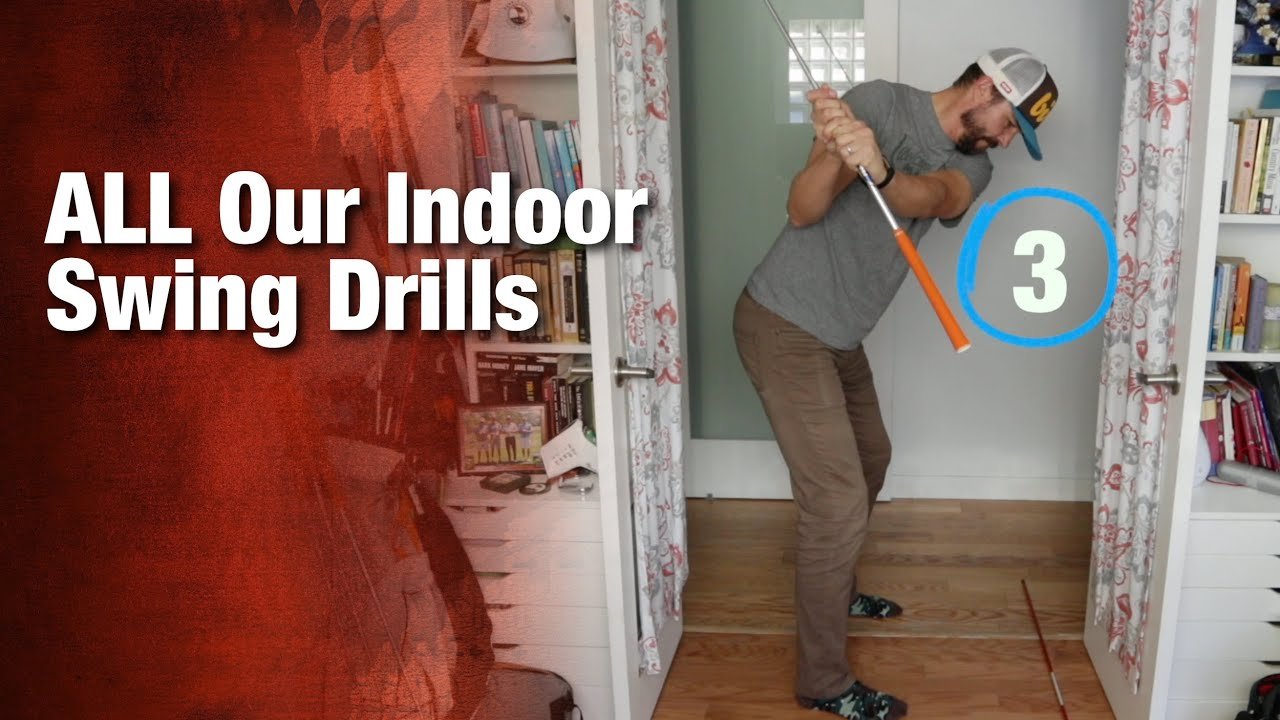
Key Takeaways From GolfersRx’s Indoor Golf Swing Drills
Indoor golf swing drills can sharpen your swing plane, tempo, posture, rotation, and impact position without hitting a single ball. In GolfersRx’s video “ALL Our Indoor Swing Drills”, the creator pulls several at-home checkpoints into one compact practice session built for golfers who want better movement, not louder effort.
From 0:00 to 0:33, the creator explains that the video combines drills for swing tempo, rotation, proper backswing, proper downswing, simplified checkpoints, balance, and swing positions. His closing line in the intro says it well: “keep it simple because that’s what these drills are.” That’s the core promise: simple reps, done slowly, can improve golf swing fundamentals before you ever get to the range.
According to GolfersRx, you don’t need a simulator bay or a bucket of balls. Around 0:34-5:00, the video demonstrates drills using an alignment stick, golf club, broomstick, book, coin, towel, wall corner, and wedge. In 2026, that matters. Range balls, indoor simulator time, launch monitor sessions, and coaching packages can add up quickly, so a low-cost year-round practice routine gives you a way to stay sharp between lessons or rounds.
- Better swing plane: use the alignment stick and book to monitor the club’s path around your body.
- Cleaner impact position: train hips slightly open, hands ahead for iron swing contact, and pressure moving into the lead side.
- Improved hip rotation and shoulder turn: rotate instead of swaying off the ball.
- Steadier weight transfer: use the coin drill to feel ground-up pressure.
- Smoother tempo and rhythm: the towel drill exposes rushed transitions and early release.
- Stronger follow-through: finish balanced with the body facing the target, not falling back or popping up.
Why Indoor Golf Swing Drills Work When You Practice Them Correctly
Indoor golf swing drills work best when you treat them as movement training, not as miniature full-speed golf swings. GolfersRx keeps the drills short and compact because the point is to isolate positions: grip technique, stance and posture, alignment, backswing checkpoints, downswing sequencing, clubface control, and balance. You’re training your body to recognize what a good swing feels like before a ball creates pressure.
The creator explains near 0:31-0:33 that these drills are meant to “keep it simple.” That simplicity is useful because most golfers don’t need ten swing thoughts at once. They need one clear checkpoint: is the club parallel to the line halfway back, did pressure stay inside the trail foot, did the hips rotate instead of slide, or did posture hold through impact?
In our experience, the biggest indoor-practice mistake is swinging too hard in a cramped room. Use half-swings and three-quarter swings, and check clearance from ceilings, walls, lights, furniture, pets, and people. If you can’t safely swing a club, use a towel, book, alignment stick, or shortened wedge grip instead.
Three practice principles make these drills more reliable:
- Short daily sessions beat occasional marathons: focused minutes, 3-5 days per week, is easier to repeat than one unfocused hour.
- Slow-motion reps improve motor learning: pausing for seconds at key checkpoints helps your brain connect feel with position.
- Feedback tools reduce guesswork: a mirror, phone video, alignment stick, or swing app can show whether your swing path matches what you feel.
- Choose one fault, such as a slice, hook, sway, early extension, or rushed tempo.
- Pick one drill from the GolfersRx video that targets that fault.
- Film from down-the-line and face-on angles.
- Perform slow reps, pausing at the checkpoint.
- Review posture, swing path, ball position reference, and clubface control.
- Repeat before moving to another drill.
Indoor Golf Swing Drills for Swing Plane and Alignment
The alignment-stick drill at approximately 0:34-1:10 is one of the most useful indoor golf swing drills because it gives you an instant visual reference for swing plane and alignment. As demonstrated in the video, the golfer lays an alignment stick on the ground, grips a club halfway down the shaft, and checks whether the club tracks parallel to the target line during the takeaway.
Swing plane sounds technical, but the idea is simple: the club should move on a repeatable tilted circle around your body. If the club gets too far outside early, many golfers steepen the downswing and hit pulls, weak slices, or glancing contact. If it dives too far inside, the downswing can get stuck behind the body, leading to hooks, blocks, or last-second hand flips.
Alignment is separate but connected. Your toes, hips, shoulders, and clubface should relate consistently to the intended target line. According to GolfersRx, you can use an alignment stick, another golf club, or even a broomstick indoors. That’s practical because the tool matters less than the reference line it gives your eyes.
- Lay the stick on the floor as your imaginary ball-target line.
- Address the stick as if a ball sits just inside it.
- Grip the club halfway down the shaft for safety and control.
- Take the club halfway back and confirm the shaft is parallel to the stick.
- Continue toward the top and check that the butt end points down toward the line.
- Return slowly to impact and finish balanced.
For slice correction, watch for a takeaway that lifts outside the line with an open clubface. For hook correction, watch for the clubhead whipping too far inside with a shut face. We tested this drill with phone video, and the most common surprise is that golfers who feel “straight back” often move the club several inches inside or outside in the first two feet.

Backswing Checkpoints: Build Width, Shoulder Turn, and Clubface Control
The book drill from approximately 2:05-2:57 turns the backswing into something you can see clearly. The creator explains that a book can train swing plane, swing sequencing, and body positioning. At address, the book is perpendicular to the target line; halfway back, it becomes parallel; at the top, it remains parallel; and the lead wrist should be flat or slightly bowed.
That lead-wrist checkpoint matters because clubface control often decides whether a technically decent swing produces a playable shot. A cupped lead wrist can leave the face open and contribute to slices or high weak fades. An overly bowed wrist can shut the face and produce hooks, low pulls, or smothered shots. You don’t need to force a tour-player position, but you do need a face that isn’t wildly open or closed at the top.
A functional backswing also pairs shoulder turn with controlled hip rotation. Your shoulders should turn more than your hips, posture should remain stable, and the head shouldn’t drift several inches away from the target. That stores power without relying on a long, disconnected arm swing. A good benchmark is simple: you should feel pressure inside the trail foot, width in the lead arm, and enough turn to let the downswing start from the ground.
| Checkpoint | What to Check |
|---|---|
| Address | Book perpendicular to target line; posture athletic; arms hanging naturally. |
| Halfway back | Book parallel to target line; club or hands not sucked behind the body. |
| Top of backswing | Book still parallel; lead wrist flat or slightly bowed; trail side loaded. |
| Transition | Lower body begins rotating; arms stay connected instead of throwing outward. |
| Impact | Book returns perpendicular; lead wrist stable; pressure moving forward. |
| Follow-through | Book parallel again; chest facing target; finish balanced. |
- Make five slow book reps.
- Pause for seconds at address, halfway back, top, impact, and follow-through.
- Repeat with a wedge gripped halfway down.
- Film down-the-line to confirm the book or club stays parallel at the right moments.
Downswing Drills for Rotation, Lag, and Impact Position
The compact wedge drill at approximately 1:35-2:04 is a direct fix for golfers who try to “drop the club into the slot” with their hands. As demonstrated in the video, the golfer grips a wedge halfway down, lets the butt end graze the lead side, then rotates the lower body so the butt end clears the lead thigh. It’s a small motion, but it teaches a big lesson.
The creator’s key point is that the club drops into position because of rotation, not because you manually throw your hands, arms, and shoulders downward. If you force the drop, the club can get steep, the low point can move behind the ball, and chunks become more likely. If the body rotates correctly, the club shallows more naturally and approaches impact from a stronger angle.
Lag in golf swing is often misunderstood. It isn’t something most amateur golfers should create by freezing the wrists or holding angle as long as possible. Better lag appears when the body turns, the arms stay connected, pressure shifts toward the lead side, and the clubhead trails naturally. That’s very different from dragging the handle with a stuck clubface.
At impact, look for these checkpoints: hips slightly open, chest rotating, hands ahead of the clubhead for iron swing contact, and pressure moving into the lead foot. Poor rotation can cause chunks, thin shots, blocks, early release, and weak contact. For driver swing practice, the same rotation matters, but the ball position is farther forward and the attack angle may be more upward.
- Make half-swings only.
- Start with the butt end of the wedge near the lead side.
- Rotate slowly from the lower body.
- Make sure the butt end clears the lead thigh.
- Hold the impact position for seconds.
- Finish with balanced chest rotation and no forced hand flip.

Weight Transfer and Balance: Stop Swaying, Start Turning
GolfersRx combines two excellent feels for weight transfer: the shoulder-club balance drill at approximately 1:11-1:34 and the coin drill at approximately 2:58-3:34. Both teach you to rotate around your body instead of sliding laterally away from the target. That difference is huge. A turn stores energy; a sway usually leaks it.
In the video, the creator warns that if you sway, you lose balance and “subsequently lose any stored power” from the backswing. That’s a clear diagnosis for many recreational golfers. They think they’re making a bigger turn, but they’re actually moving their center too far off the ball, making it harder to return the low point to the same place.
The coin drill is especially useful because it gives your trail foot a pressure target. Place a coin under the ball of your trail foot, rotate into the backswing, and keep pressure on the inside of that foot. If pressure rolls to the outside edge, you’re likely swaying. During the downswing, press harder into the coin to feel power build from the ground up.
Ball flight can reveal the fault. A sway often causes fat shots, blocks, weak slices, and inconsistent low-point control. A reverse pivot, where weight falls toward the lead side in the backswing and back foot in the downswing, can cause thin contact, weak pulls, and loss of driver distance. Neither pattern supports consistent power.
- Start with no-club rotations.
- Add a club across your shoulders and turn around your spine angle.
- Move the trail foot slightly back and up on the toe for balance feedback.
- Add the coin under the ball of the trail foot.
- Stop immediately if you lose balance or pressure rolls outside the trail foot.
Tempo and Rhythm Drill: Use a Towel to Smooth Out the Swing
The towel drill from approximately 3:35-4:08 is one of the easiest indoor golf swing drills to try because it removes the temptation to muscle the club. The video shows a thin towel rolled up with a knot at the end, gripped like a club, and swung to create smoother rhythm. If you rush, the towel tells on you right away.
The reason it works is simple: a flexible towel won’t behave like a rigid club. It punishes snatching the club away, rushing transition, casting from the top, and early release. The towel only moves properly when the hands, arms, shoulders, and body sequence together. According to GolfersRx, you can’t easily start down before finishing the backswing, and you can’t cast without feeling the towel snap early.
Tempo and rhythm change slightly by club, but the pattern should still feel organized. A driver swing can feel wider and more sweeping because the ball is teed forward. An iron swing should still be smooth, but the body stays more centered over the ball to control low point. Short game mechanics are smaller and quieter, yet they still benefit from the same one-piece takeaway and balanced finish.
Try a simple count: “one” to finish the backswing, “two” to change direction, and “three” to finish balanced. The exact speed matters less than repeatability. Many smooth players look slow, but their sequencing produces speed at the right time.
- Make towel swings.
- Listen for a smooth swish rather than a violent snap.
- Pause if the towel fires early from the top.
- Immediately make five slow club rehearsals without a ball.
- Finish every rep in balance for at least seconds.

Stance and Posture Checks You Can Do Against a Wall
The wall-corner setup drill at approximately 4:09-4:41 gives you a simple way to check stance and posture without a coach standing nearby. The creator demonstrates standing tall with the club pointing straight out, bending from the hips until the club touches the ground, adding a little knee flex, and using the edge of a wall to verify body position.
Good setup starts before the club moves. Bend from the hips, keep the spine neutral, let the arms hang naturally, and add slight knee flex. Avoid sitting too low like you’re in a squat, and avoid standing so upright that the arms reach for the ball. Your grip technique matters here too: if your hands are tense or the grip sits poorly, posture and takeaway often compensate.
The video’s wall checkpoint is specific: line your toes with the edge of the wall. When you finish your setup, your knees should be slightly behind the wall, and your shoulders should be in line with or slightly ahead of the wall. That gives you a repeatable reference for whether you’re too bent over or too upright.
Even without a real ball, use a consistent imaginary ball position. For driver, place it forward near the lead heel. For mid-irons, use center-to-slightly-forward. For wedges, start closer to center, then adjust depending on trajectory and short game mechanics. Changing ball position randomly indoors trains inconsistent contact outdoors.
- Stand tall with the club pointing forward.
- Hinge from the hips until the club reaches the floor.
- Soften the knees without squatting.
- Check toes, knees, and shoulders against the wall edge.
- Place an imaginary ball in the correct position.
- Rehearse the takeaway without changing spine angle.
Fix Early Extension and Maintain Posture Through the Swing
The trail-hand posture drill at approximately 4:42-5:00 helps you feel how to keep space through the backswing and downswing. The video shows the golfer getting into setup, moving the club away, then mimicking the swing with the trail hand while maintaining posture. It’s slow, controlled, and very useful for early extension.
Early extension happens when the hips move toward the ball and the upper body stands up too soon. Once that space disappears, the hands have to rescue the shot. Common results include shanks, heel strikes, blocks, hooks, thin contact, and a release pattern that flips at the ball instead of rotating through it.
Maintaining posture longer doesn’t mean freezing your spine angle like a statue. It means keeping enough hip depth and chest angle so the body can rotate, the arms can extend, and the club can release around the body. A good follow-through should feel balanced and turned, not jammed or lifted.
Mobility can influence this. Limited hip internal rotation, a tight thoracic spine, weak glutes, or poor hamstring mobility can make posture harder to hold. Before practicing these indoor golf swing drills, spend 3-5 minutes on gentle hip hinges, thoracic rotations, glute bridges, and slow split-stance turns. If a movement causes pain, stop and scale it down.
- Rehearse five trail-hand backswings from setup.
- Rehearse five slow downswings while keeping the trail hip back.
- Make five full no-ball motions.
- Keep the chest angled toward the floor through impact.
- Finish balanced instead of popping up early.
A Beginner-to-Advanced Practice Plan Using Indoor Golf Swing Drills
A good plan matters because random YouTube golf swing tips can easily become noise. The GolfersRx video gives you simple checkpoints, but you’ll improve faster if you organize them by skill level and fault pattern. Don’t try all the drills every day. Pick the ones that match your current miss.
Beginner plan: practice minutes, days per week. Focus on wall posture, alignment-stick plane, and towel tempo. Your goal is a repeatable setup, a basic swing path, and a balanced finish. Track just three things: posture, takeaway direction, and whether you can finish without falling.
Intermediate plan: practice 15-20 minutes, days per week. Add the book drill, coin drill, wedge rotation drill, and a simple ball-flight journal after range sessions. Write down whether misses are slices, hooks, chunks, tops, pulls, or blocks. After sessions, patterns usually appear. For example, blocks plus chunks may point to sway and poor rotation; pulls plus slices may point to an outside takeaway and open face.
Advanced plan: practice 20-30 minutes, days per week. Add phone video, swing apps, and launch monitor data when available. Track face angle, club path, attack angle, low point, and strike location, but don’t obsess over every number. Data-driven practice works when it confirms a pattern, not when it gives you ten new swing thoughts.
Common mistakes include mixing too many instructors at once, applying driver advice to wedge shots, ignoring grip technique, chasing positions without ball-flight feedback, and making full-speed indoor swings in unsafe spaces. For comparison, use GolfersRx for simple at-home checkpoints, technical channels such as Athletic Motion Golf for deeper mechanics, short-game specialists such as Short Game Chef for wedges and putting, and fitness-focused golf channels when mobility or injury prevention is the limiting factor.
Questions Golfers Ask About Swing Speed, Power, and Improvement
Golfers often ask power questions when the real answer starts with movement quality. The indoor golf swing drills demonstrated by GolfersRx train the patterns behind smoother speed: centered rotation, better sequencing, stable posture, cleaner impact, and a balanced follow-through.
Who has the smoothest golf swing ever? Many golfers cite Ernie Els, Fred Couples, Adam Scott, or Louis Oosthuizen because their swings show balance, tempo and rhythm, efficient sequencing, and effortless-looking speed. The common thread isn’t laziness; it’s that their bodies, arms, and clubs move in order.
How far should a year old man hit a driver? Many recreational male golfers around drive the ball roughly 200-240 yards, depending on swing speed, contact quality, launch conditions, fitness, and equipment fit. A player with solid center contact and a fitted driver can outdrive someone swinging harder with poor strike location.
What is the best exercise to improve golf swing? There isn’t one magic exercise, but hip hinges, thoracic rotations, split-stance rotations, glute bridges, and medicine-ball rotational throws can support better swing mechanics when performed safely. These exercises connect directly to the rotation, posture, and ground-pressure drills in the GolfersRx video.
What generates the most power in a golf swing? Power comes from efficient ground force, weight transfer, hip rotation, shoulder turn, sequencing, centered contact, and clubhead speed. It does not come from simply swinging harder with the arms. If the face, path, and low point are unstable, extra effort often makes the miss bigger.
Conclusion: Turn Simple Indoor Reps Into Better Golf Swing Improvement
The best part of the GolfersRx video is that it makes practice feel doable. You don’t need a net, a simulator, or minutes of free time. You need one clear goal, one household training aid, and enough discipline to move slowly enough that your body learns the checkpoint.
Start with the fault that costs you the most shots. If you slice, use the alignment-stick and book drills to check swing plane and clubface control. If you chunk or block shots, use the coin and wedge rotation drills to improve weight transfer and downswing sequencing. If you rush from the top, use the towel drill until the transition feels smooth instead of snatched.
Your next 7-day plan can be simple: practice minutes per day, rotate through posture, plane, weight transfer, and tempo, and film two sessions from down-the-line. Then take the same feel to the range and compare ball flight. That’s how indoor golf swing drills become real improvement instead of living-room choreography.
As the creator explains in the video, the drills are simple on purpose. Keep them compact, stay safe indoors, and use feedback. Better golf swing fundamentals are built one clean rep at a time.
Key Takeaways
- GolfersRx’s indoor golf swing drills use simple household items to train swing plane, tempo, posture, rotation, weight transfer, and impact position without hitting balls.
- The best indoor practice is slow, compact, and feedback-driven; use phone video, mirrors, alignment sticks, or swing apps to confirm what you’re actually doing.
- Ball flight patterns help diagnose swing faults: slices, hooks, chunks, blocks, tops, and pulls often connect to specific issues in clubface control, path, pressure, or posture.
- Beginners should focus on posture, alignment, and tempo; intermediate and advanced golfers can add book checkpoints, coin pressure drills, wedge rotation drills, and launch monitor data.
- Keep indoor swings safe and purposeful: half-swings, enough clearance, one fault at a time, and balanced finishes.
Frequently Asked Questions
Who has the smoothest golf swing ever?
Many golfers point to Ernie Els, Fred Couples, Adam Scott, or Louis Oosthuizen because their swings show balance, tempo, rhythm, and efficient sequencing. “Smooth” doesn’t mean slow; it means the body, arms, and club work together without wasted motion.
How far should a year old man hit a driver?
Many recreational male golfers around age drive the ball about 200-240 yards, depending on swing speed, strike quality, launch conditions, fitness, and equipment fit. Center contact and proper launch can matter more than raw effort.
What is the best exercise to improve golf swing?
Good options include hip hinges, thoracic rotations, split-stance rotations, glute bridges, and medicine-ball rotational throws when safe and appropriate. These exercises support the same posture, rotation, and weight-transfer patterns trained in the GolfersRx indoor drills.
What generates the most power in a golf swing?
Golf swing power comes from efficient ground force, weight transfer, hip rotation, shoulder turn, sequencing, centered contact, and clubhead speed. Swinging harder with only the arms often reduces control and can make slices, hooks, and poor strikes worse.
Can indoor golf swing drills really improve ball striking?
Yes, if you practice them slowly and use feedback such as a mirror, phone video, alignment stick, or swing app. Indoor drills improve movement patterns, but you should still test them with real ball flight at the range or on the course.
How often should you practice indoor golf swing drills?
A practical starting point is minutes per session, 3-5 days per week. Short, focused sessions are usually better than rare long sessions because you can repeat the same posture, swing path, tempo, and balance checkpoints more consistently.